There is a recurring theme in options discussions that has always bothered me. Someone sells a covered call on a stock they own. The stock subsequently rises sharply. The conversation becomes: "You gave up the upside." Then comes the next question: "Was the option premium enough to compensate you for the opportunity cost of that lost upside?"
It sounds reasonable. But we are starting the discussion from the wrong place, comparing two entirely different financial instruments and treating the variance in their outcomes as though something went wrong. Before we can judge any outcome, we need to understand what we are actually trading. That is what this piece is about.
What a Derivative Actually Is
A derivative is a financial contract whose value is derived from, and depends on, an underlying asset. The underlying is the base: a stock, an ETF, an index, a currency. The derivative is built on top of it. It does not replace the base. It references it.
The Options Clearing Corporation, the central clearinghouse for U.S. listed options, defines an option this way: "An option is a financial contract between a buyer (holder) and a seller (writer) that gives the buyer the right, but not the obligation, to buy or sell a specified amount of an underlying asset at a predetermined price within a set time frame." A call gives the right to buy. A put gives the right to sell. The agreed-upon price is the exercise price, or strike. The price the buyer pays and the seller receives is the premium. The last date the option can be exercised is the expiration date, after which the contract ceases to exist.
Most listed options carry standardized terms: the underlying interest, the expiration date, the exercise price, whether the option is a call or a put, whether it is physical delivery or cash-settled, the multiplier, the exercise style, automatic exercise provisions, and adjustment provisions. Options with identical standardized terms are identical and form an options series. That standardization is what makes a liquid secondary market possible, so holders and writers can close out positions by offsetting trades, although a liquid market is not guaranteed for every option at every moment.
The risks are real and specific. An option is a wasting asset. It can expire worthless, and the holder loses the entire premium paid. A writer of a covered call forgoes the appreciation of the underlying above the strike, yet continues to bear the risk of a decline in the shares. Assignment, the process by which a writer is required to fulfill the contract, can occur at any time while an American-style option, the usual style for listed stock options, is exercisable. These are not side effects. They are the terms of the contract.
The quoted definition is from the Options Clearing Corporation's Options 101 primer. The rest of this section is drawn from the OCC's Characteristics and Risks of Standardized Options, also called the Options Disclosure Document.
Every Instrument Lives in Its Own Universe
Every instrument lives in its own universe. The stock has one. The option has another. Each has its own rules, its own payoff, its own clock. You choose which universe to inhabit, and once you have chosen, you do not borrow the scorecard from the other. You do not judge one universe by the rules of the other.
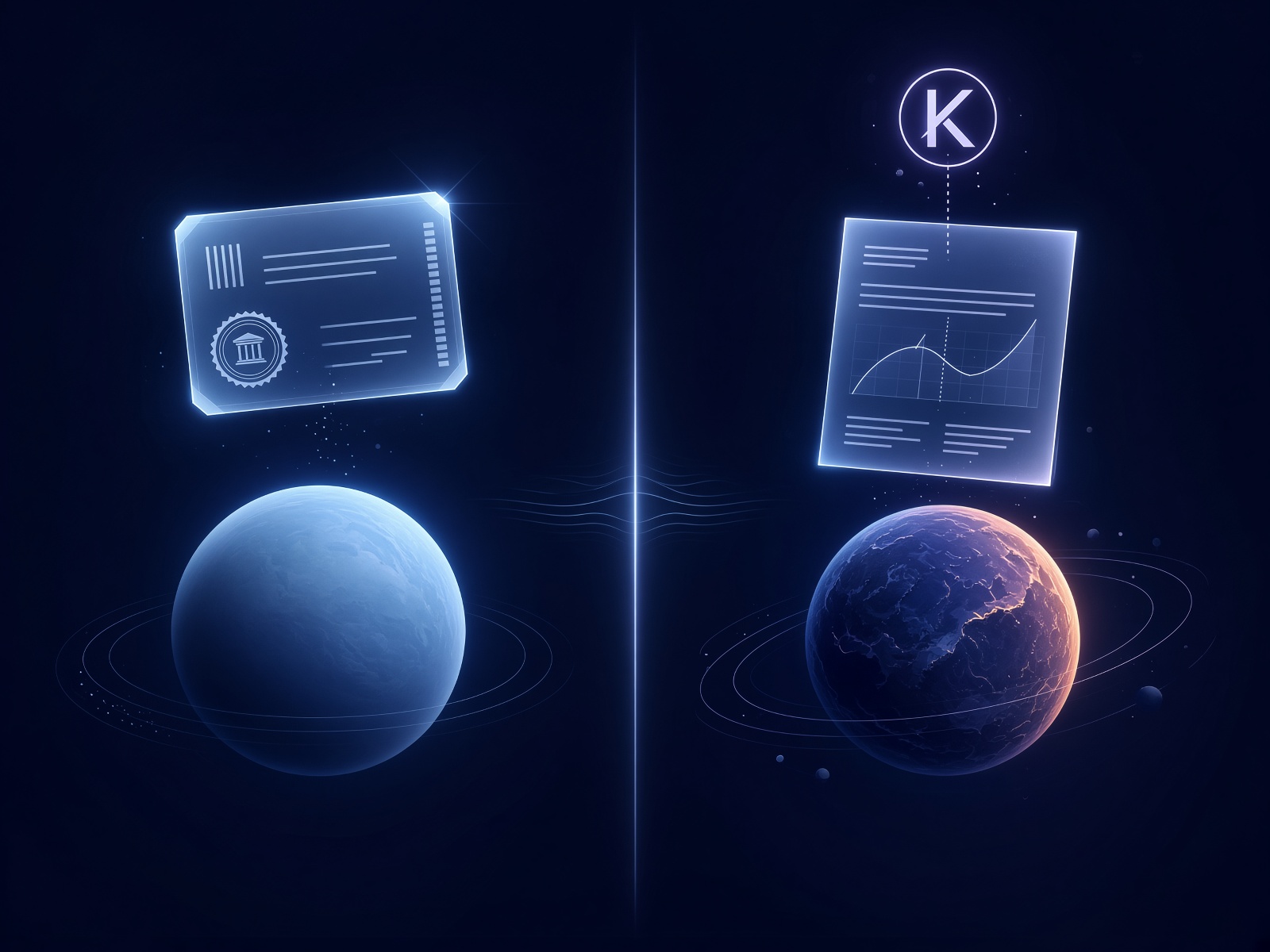
Figure 1. Two universes: Universe A holds the stock. Universe B holds the contract. The line between them is the point of the article.
Universe A: The Underlying
You own 100 shares of XYZ. That is Universe A.
The asset can rise, fall, or go nowhere. Nobody holds a contractual right to take it from you at a pre-agreed price on a pre-agreed date. If XYZ goes from $100 to $150, that $50 is yours. That is not a strategy. It is the nature of unencumbered ownership.
Universe B: The Derivative Structure
Now you keep the same 100 shares and sell a $120 call. You have entered Universe B.
You did not sprinkle "extra income" onto the old position. You built a new one: stock plus a sold call. The strike is a binding, time-bounded claim on the shares. In exchange for that claim, and the risk of assignment, you receive a premium.
The premium is not a bonus. It is the market price of the obligation you sold.
The stock is still stock. The option is still an option. The stock moves with the business and the market. The option also moves with time, implied volatility, rates and dividends. Binding them together does not make them the same instrument. It creates a third thing: a combined payoff with a ceiling.
Show as table
| Stock at expiration | A: stock alone | B: covered call | B minus A |
|---|---|---|---|
| $80 | −$20 | −$16 | +$4 |
| $100 | $0 | +$4 | +$4 |
| $120 | +$20 | +$24 | +$4 |
| $124 | +$24 | +$24 | $0 |
| $150 | +$50 | +$24 | −$26 |
The Myth of "Lost Upside"
XYZ goes to $150. Someone says you "lost $30 of upside."
Compared with what?
Compared with Universe A, yes. The paths diverge. That is not evidence that the covered call failed. It is evidence you chose Universe B.
We do not talk this way about ordinary contracts. If you rent your house for a year and give the tenant the right to buy it at a pre-agreed price, and sale prices in the neighborhood jump 20 percent, you did not "lose the upside of living in an empty house you could have flipped next month." You sold occupancy and a right to buy, and you were paid for both. Gold and silver make the same point in another register: if you exchange one for the other, later performance is not a refund claim. Different assets. Different terms.
A covered call is closer to the lease than to the swap. You still own the shares. You sold a slice of their future, the appreciation above the strike, for a defined window, and you were paid for that slice. Derived from the stock is not identical to the stock.

Figure 3. A defined right at a defined price: You keep the house unless the buyer uses the right. The tag is the price the buyer may pay later; the cash is what they pay now for that right. That is closer to a covered call than a simple swap of assets.
Investor and Trader Are Not Interchangeable
There is nothing inferior about long-term ownership. There is nothing inferior about trading defined contracts. Mixing both in one portfolio is ordinary.
They are still different jobs.
An investor lives with the open-ended path of the underlying.
A derivatives trader lives with terms: strike, expiry, premium, assignment, and a ceiling fixed on day one.
The moment you write a call against shares, five things change at once: the instrument, the objective, the payoff, the risks, and the clock. Evaluation has to change with them. Judging Universe B with Universe A's scorecard is how "lost upside" becomes a moral, not a calculation.
Ask These Four Questions First
Before "How much upside did I give up?"
- What position did I actually choose?
- What contractual exposure did I accept?
- What did I receive in exchange?
- How did that position perform against the alternative I could have chosen, not the one I now wish I had kept?
Answer those, and the arithmetic is no longer mysterious. A $120 covered call on $100 stock, later at $150, did not secretly lose $30. It delivered the contracted cap plus the premium. Universe A would have delivered something else. That is a comparison. It is not a defect.
Do not compare apples and oranges before you know why they are different. Instrument first. Outcomes second.
Let the math decide. 🦉
— Sam Vishwas, Founder, OTS Ullu | Pleasanton, CA | 29 September 2026
Sources
-
OCC
The Options Clearing Corporation. Options 101: Basic Concepts and Terminology. Source of the option definition quoted above.
-
OCC
The Options Clearing Corporation. Characteristics and Risks of Standardized Options (the Options Disclosure Document). Standardized terms, exercise and assignment, and the risks of buying and writing options.
Related
- What's Really at Stake When You Sell an Option
- The Rule I Never Believed: Why Counting Rolls Is the Wrong Way to Manage Short Options
- The Trader's Guide to Option Adjustments
- I Bought Life360 Near the Top. I Was Ready for the Fall.
Watch and Listen
XYZ is a hypothetical ticker, and its prices and strikes are illustrative. Examples exclude commissions, fees and taxes. This article is educational. It explains how a covered call changes the position you hold and how to evaluate it; it does not constitute a recommendation to buy or sell any security or to use any particular strategy. Options involve risk and are not suitable for all investors. A covered call caps the upside of the shares above the strike while leaving the full downside of the shares in place. American-style options, the usual style for listed equity calls, can be assigned at any time before expiration. Before trading options, read Characteristics and Risks of Standardized Options, available from your broker or The Options Clearing Corporation.