
Educational only — not investment advice. Verify current OCC memos before trading any adjusted contract.
You've priced the volatility and mapped the Greeks. Then the underlying splits, pays a surprise dividend, or gets bought out — and your contract quietly gets rewritten. This guide explains exactly how the Options Clearing Corporation (OCC) rewrites it, why the math stays fair, and what it means when you are short the call.
01 — The One Equation That Governs Everything
Corporate actions would otherwise hand a windfall to one side of a contract and a loss to the other. The OCC — the single issuer and clearinghouse for every listed U.S. equity option — adjusts the contract to hold its economics still. Learn this one invariant and every scenario becomes arithmetic.
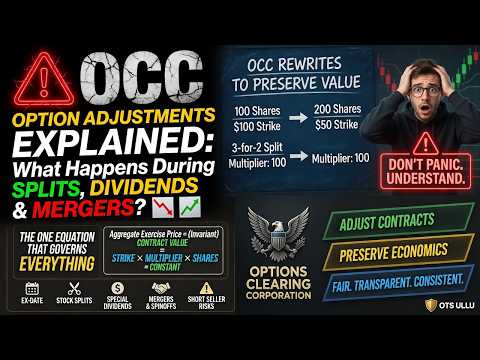
The invariant: Aggregate Exercise Price = Strike × Multiplier. The OCC changes whatever it must (contract count, strike, multiplier, or deliverable) so that this number, and the total value of what you receive or deliver on exercise, stays constant across the event.
Aggregate Exercise Price = Strike × Multiplier. Hold that constant, and every adjustment becomes arithmetic.
There are only two ways to keep that promise:
- Give you more contracts. Clean whole-number splits (2-for-1, 4-for-1) multiply your contract count and divide the strike. The deliverable stays a standard 100 shares, so liquidity is unaffected.
- Rewrite the single contract. Odd splits, reverse splits, special dividends, and mergers keep your contract count the same and instead adjust the strike, the multiplier, and the deliverable. The result is a non-standard ("adjusted") contract.
Governing law: Stock events follow By-Laws Article VI, Sections 11 and 11A. Mergers and mandatory conversions follow Article XII. Everything that follows is those sections in plain English.
02 — When Adjustments Happen: The Ex-Date
This is the detail most guides skip, and it decides whether your near-dated position is even affected. The adjustment takes effect on the corporate action's ex-distribution date. Contracts that expire before the ex-date settle on the old, pre-event terms. Contracts living on or past the ex-date get rewritten.
Practical rule: A short call expiring the Friday before a Monday ex-date is not adjusted — it settles as a plain 100-share contract. The same strike expiring the following week is. When a split or distribution is on the calendar, sort your ladder by expiration against the ex-date before you assume anything.
03 — Forward Splits: Even and Odd

Even splits multiply your contracts; odd splits rewrite the single contract's strike, multiplier, and deliverable.
Companies split forward to lower the share price. Share count rises, price falls proportionally, and the OCC keeps your position whole in one of two ways depending on whether the ratio divides evenly into 100.
Even (whole-number) splits — 2-for-1, 4-for-1
The tidy case. Under current OCC policy (By-Laws Art. VI §11A), when a split results in a whole number of additional shares per existing share, your contract count multiplies, your strike divides by the ratio, and the deliverable stays a standard 100 shares. No non-standard symbol, no liquidity penalty.
1 contract at $100 strike becomes 2 contracts at $50 strike. Aggregate exercise value stays $10,000. Deliverable remains 100 shares per contract.
Odd (fractional) splits — 3-for-2, 4-for-3
Multiplying contracts by 1.5 would create half a contract, which is not allowed. So the OCC keeps your contract count the same and instead divides the strike, raises the multiplier, and expands the deliverable — all by the split ratio.
Before: 1 contract, $37.20 strike, multiplier 100, 100 shares deliverable.
After (PCAR1): 1 contract, $24.80 strike (÷1.5), multiplier 150 (×1.5), 150 shares deliverable.
Aggregate exercise value: $3,720 both before and after. A quoted premium of 1.00 now equals $150.
| Action | Contracts | Strike | Multiplier | Deliverable |
|---|---|---|---|---|
| Even split (2:1) | ↑ ×2 | ↓ ÷2 | — 100 | — 100 sh |
| Odd split (3:2) | — 1 | ↓ ÷1.5 | ↑ 150 | ↑ 150 sh |
04 — Reverse Splits and Cash-in-Lieu
Companies reverse-split to lift a low share price, often to hold a listing. Here the pattern inverts: your contract count, strike, and multiplier all stay the same, and only the deliverable shrinks by the ratio. Since the strike does not move, the aggregate exercise price is automatically preserved.
Before: stock at $0.50, 100-share deliverable, $50 exercise value. After: stock at $5.00, 10-share deliverable, still $50 exercise value. Strike unchanged at $0.50.
When the ratio does not divide cleanly
A 1-for-3 reverse turns a 100-share deliverable into 33.33 shares. The deliverable rounds down to 33 shares, and the missing 0.333 is settled as cash-in-lieu (CIL), fixed in dollars at the time of adjustment. The same CIL mechanism appears anywhere a corporate action leaves a fractional deliverable — odd forward splits and spinoffs included.
Cash-in-lieu note: The cash amount is locked at adjustment. The holder gives up any future time value or price movement on the fractional piece.
05 — Dividends: Ordinary vs. Special
Ordinary dividends — no adjustment, ever
A dividend paid on a regular schedule is "ordinary" — regardless of size — and the OCC does not adjust for it. The market has already priced the expected stream into the option. What defines "ordinary" is whether the company pays pursuant to a regular policy or practice, not the dollar amount. (By-Laws Art. VI §11A)
Special dividends — material, and only sometimes adjusted

A one-off special distribution is measured against the contract's own deliverable — not just the per-share figure.
A one-off special distribution triggers an adjustment only if it is material: at least $0.125 per share, i.e. $12.50 per standard contract. The threshold is measured against the contract's own deliverable, not just the per-share figure. This matters for already-adjusted contracts.
A $0.15 special dividend on a standard 100-share contract = $15.00 (above threshold → adjusted). The identical $0.15 on a non-standard 50-share deliverable = $7.50 (below threshold → not adjusted). (SR-OCC-2024-003)
Adjustment methods for special dividends
- Method A (default): Every strike drops by the dividend amount; the deliverable stays 100 shares.
- Method B: When reducing the strike would drive it to zero or below, the OCC leaves the strike alone and adds the dividend as a cash component to the deliverable. The contract now delivers 100 shares plus fixed cash, and the symbol changes.
Strikes reduced by $1.00 across the board. Deliverable remained 100 shares.
06 — Mergers, Spinoffs, and Liquidations
Here the deliverable simply becomes whatever a shareholder received in the deal — cash, stock of another company, a mixture, or other property.
Cash mergers (all-cash buyouts)
The stock stops trading, so the deliverable converts to the fixed cash figure and the option's expiration is accelerated (Rule 807). Post-conversion there is no underlying left to move, so out-of-the-money options simply expire worthless. Settlement runs through OCC's cash system as the difference between the extended strike and the cash deliverable.
Acquired for $14.50 net cash per ADS. Each option's deliverable became roughly $1,450 in cash per contract. Expirations accelerated. Non-transferable contingent value rights were excluded from the deliverable.
Cash-and-stock mergers
The deliverable carries both legs. When Bristol-Myers Squibb bought Celgene, each CELG share received $50.00 cash + 1 BMY share + 1 tradeable CVR. Scaled to a 100-share contract, the adjusted deliverable became $5,000 cash + 100 BMY shares + 100 CVRs. Tradeable CVRs ride along; non-transferable ones are excluded.
Spinoffs
The parent's option deliverable expands to include the new child stock on a pro-rata basis, plus cash-in-lieu for any fractional shares.
Shareholders received 0.241917 WBD per T share. One AT&T contract was adjusted to deliver 100 shares of T plus approximately 24 shares of WBD, with cash-in-lieu covering the leftover fraction.
Bankruptcies and liquidations
- Shares canceled for nothing: Calls become worthless. Put holders, on exercise, receive the strike value in cash and deliver no shares — the deliverable has collapsed to zero.
- Shares still exist (delisted or trading OTC): Options continue to settle into those shares; exchanges typically restrict them to closing-only transactions.
- Trading halted: Option trading is generally halted alongside the stock, though exercise rights usually remain.
Note on tender/exchange offers: OCC generally makes no adjustment for tender or exchange offers (cash, stock, or otherwise), even if coercive. Only a subsequent merger or consolidation triggers adjustment. (Interpretation .03 to Art. VI §11)
07 — American vs. European: Why Style Drives Dividend Risk
American-style options can be exercised any time before expiration. European-style options only at expiration. Most single-name stock and ETF options are American; many broad-based index options are European.
Because the OCC never adjusts for ordinary dividends, the only way to capture one through an option is to own the shares over the ex-date. A holder of a deep in-the-money American call may exercise early — the day before ex — purely to collect the dividend.
Assignment risk if you write calls: If you are short an American call that is in-the-money into an ex-dividend date, you carry early-assignment (dividend) risk: you can be assigned the night before ex and forced to deliver shares. European options are structurally immune because early exercise is impossible.
08 — The Writer's Desk: Impacts on Your Short Options

On the writer's desk, an adjustment lands on the obligation side of your book — and the surprises are operational, not theoretical.
Most explainers stop at the option holder. But if you sell covered calls and cash-secured puts — especially with share retention as the goal — an adjustment lands on the obligation side of your book. The surprises are operational, not theoretical.
Your deliverable can change under you. After a 3-for-2 split, your one short call no longer obligates 100 shares — it obligates 150. After a cash-and-stock merger it may obligate shares of a company you never traded, plus cash. On assignment of an adjusted put, your capital requirement can be materially larger than the "strike × 100" you sized the trade on.
- Assignment still happens on adjusted contracts. A non-standard symbol does not shelter you; the short position carries the new deliverable obligation in full.
- Your Greeks re-scale. After a 4-for-1 you hold four contracts, each with one-quarter the per-contract theta and vega. Aggregate exposure is preserved, but per-line risk reports look nothing like before. Confirm units before you react.
- Liquidity evaporates. Adjusted series trade with wide spreads because market-makers concentrate in the fresh standard 100-share series listed alongside them. Rolling or closing an adjusted short can cost you the spread.
- Share-retention math shifts. If the whole point is keeping the shares, re-check assignment probability against the new strike and deliverable the moment the memo posts — the cushion you built may have moved.
The discipline: The instant any name in your book has a corporate action on the calendar: pull the OCC memo, re-read your deliverable, re-price your assignment risk against the ex-date, and decide before liquidity thins — not after.
09 — Reading an Adjusted Contract Without Getting Fooled
- Look for the numeral. When a deliverable stops being a plain 100 shares of one stock, the OCC appends a digit to the root (PCAR → PCAR1) and it increments with each successive adjustment (…1, …2). A trailing number is your flag to read the memo.
- A "cheap" strike is usually not a gift. An adjusted $90 call quoted at $1.00 next to a standard $90 call at $10.00 is not arbitrage — the adjusted one likely delivers far fewer shares or carries a different multiplier. Check the deliverable before you get excited.
- Do the exercise-value math, not the strike math. Intrinsic value on an adjusted contract is (deliverable value − strike × multiplier). Screens that assume a 100 multiplier will mislead you.
10 — Verify It Yourself in Ninety Seconds
Never trade an adjusted contract on a summary, including this one. The OCC publishes an Information Memo with the exact, official terms of every adjustment, and issues one only when an adjustment is actually made.
- Search by symbol or memo number at infomemo.theocc.com — the memo names the effective date, new multiplier, strike divisor, and precise deliverable.
- Stock splits and dividends are governed by By-Laws Article VI, Sections 11 and 11A.
- Mergers and conversions by Article XII.
- Cash-settlement acceleration by Rule 807.
- The dividend framework (the $0.125 / $12.50 threshold, ordinary-vs-special test, and strike-vs-cash methods) sits in OCC's interpretive guidance, last refreshed via SR-OCC-2024-003.
Never trade an adjusted contract on a summary — including this one. The controlling OCC Information Memo governs any specific event.
Every Example, Sourced
-
#51729
PACCAR (PCAR) — 3-for-2 forward split, ex 02/08/2023. OCC Information Memo #51729.
-
#53136
A-Mark Precious Metals (AMRK) — $1.00 special distribution, ex 09/11/2023. OCC Information Memo #53136.
-
#52249
Amryt Pharma (AMYT) — all-cash merger at $14.50/ADS. OCC Information Memo #52249.
-
#50289
AT&T (T) → Warner Bros. Discovery (WBD) — spinoff, 0.241917 WBD per T share. OCC Information Memo #50289.
-
Filings
Celgene / Bristol-Myers Squibb — cash-and-stock merger terms per SEC merger filings.
-
Rulemaking
Dividend framework — ordinary-vs-special test and $0.125 / $12.50 materiality threshold per SR-OCC-2024-003. Governing law: By-Laws Art. VI §§11, 11A; Art. XII; Rule 807.
This guide explains the mechanics of OCC contract adjustments. It is not a recommendation to buy, sell, write, or hold any option or security, and it is not legal, tax, or financial advice. Contract adjustments are made case-by-case; the controlling OCC Information Memo governs any specific event. Verify current terms before acting. Past memos and examples are for illustration only.